The usual Florida Keys itinerary is a checklist: snorkel the reef, cross the Seven Mile Bridge, swim at Bahia Honda, paddle the mangroves, watch a sunset. All of those are worth doing. Whether they work on a given day depends on things the checklist leaves out: the water level, the wind, the heat, the light, and how much energy your group has left.
This guide is not a list of must-dos. It is how we chose between them on a September 2026 trip with a mixed-age group, what worked for us, and what to check before you commit. Where we describe our own days, we say so and give the date. Where we pass along planning facts we did not test ourselves, we say that too, and we link the source.
The plan is the water and the light
Before you pick what to do, decide how you will decide. Three things shaped our choices.
The water. Depth, clarity and calm change with tide and wind. A route on a park map may not have enough water in it on the day. A reef trip is a boat ride first and a snorkel second.
The effort before the fun. Carrying gear, inflating a board, boat time, waiting — these are paid before the activity starts, and they decide how much of the day is left afterward.
The light. Sunset in the Keys is not something you attend. It happens while you are driving, eating or packing up. It is worth knowing where you will be when it does.
Pennekamp: the reef is a boat ride first
From our visit, 5 September 2026. We snorkelled at John Pennekamp Coral Reef State Park in Key Largo. The snorkelling was very good that day: the fish were plentiful and many were big, and the water temperature was perfect. We took videos from the boat and in the water. We would snorkel there again. We opened the Adventure Quest Pennekamp adventure while we were there and did not play it.
What to know before you book, from the park concession’s published tour information, checked 8 September 2026: reef snorkel tours run about two and a half hours, roughly forty-five minutes by boat each way with about an hour in the water. Listed departures are 9 a.m., 10:30 a.m., noon, 1:30 p.m. and 3 p.m. Safety vests are provided; masks, fins and snorkels can be rented. Reservations are recommended and must be confirmed in person at least an hour before departure, and tours carry minimum passenger requirements. Prices and schedules can change.
Park entry is separate from the tour. On the park’s fee page (checked 8 September 2026): $8 per vehicle plus 50 cents per person for up to eight people, $4.50 for a single-occupant vehicle, and $2.50 per pedestrian or cyclist. The park is open 8 a.m. to sunset.
For a family, the question is not whether the reef is worth it. It is whether everyone in your group is comfortable with the boat time on either side of the snorkelling, and whether a listed departure fits the rest of your day. The concession page we checked does not state a minimum age or swimming requirement; ask when you book.
Crossing the Seven Mile Bridge
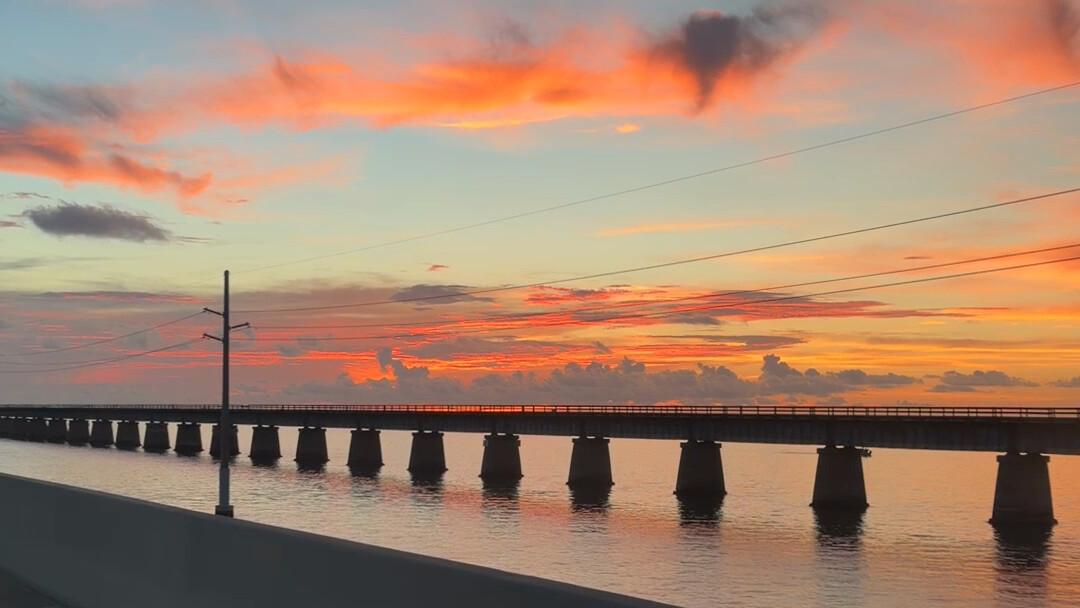
From our visit, 6 September 2026. We crossed the Seven Mile Bridge at sunset, with open water on both sides and the old railroad bridge running alongside. We photographed and filmed the crossing.
Pigeon Key: the train, the tour and the sharks
From our visit. We took the train across the Old Seven Mile Bridge to Pigeon Key, took the guided tour, and fed the sharks during the visit. Pigeon Key is the small island beneath the bridge, a National Historic Landmark connected to the building of Flagler’s Overseas Railroad.
Shark feeding was part of our visit. It is not automatically part of every visit. The operator’s tour page, checked 8 September 2026, lists four train departures a day, seven days a week — 10 a.m., 11:30 a.m., 1 p.m. and 2:30 p.m. — and marks the 11:30 a.m. and 1 p.m. departures as including shark feeding. Schedules can change, so confirm with the operator which departure includes it before you promise it to anyone.
The other way to reach the island is on foot or by bike along the restored Old Seven Mile Bridge, which the Florida Keys tourism council announced reopened in January 2022 as a 2.2-mile span closed to vehicles, with a small parking area at the Marathon end. For a mixed-age group, the decision is train or walk: the walk is about two miles each way on an open bridge with little shade; the train avoids it. Check current admission and tour length with the operator; we are not quoting them here.
Curry Hammock: the plan that changes after you launch
From our visit, 6 September 2026. Curry Hammock State Park is in Marathon, in the Middle Keys. It was our paddling afternoon, and an example of why you plan a decision rather than a route.
Our group used an inflatable stand-up paddleboard we brought and a tandem kayak rented at the park. The rental was self-service through a QR-code kiosk — photo documentation, QR-operated locks, numbered equipment slots, Apple Pay — so everyone launched from the same place.
We headed for the mangroves first. The water became too shallow for us to continue, so we turned around and went back toward open water. The park’s paddling map shows two mapped loops through the mangroves and a sandbar about a third of a mile from the launch. We did not paddle the loops.
The sandbar is not visible from the launch. We could tell roughly where it was because boats had gathered near it. That is an observation, not a way to find it: boats may not be there, and gathered boats are not navigation. The paddleboarder reached the sandbar. The kayakers turned back before it because the tandem kayak’s fixed seat was not comfortable for one of them. That was about the boat and the person, not the route.
The park is open 8 a.m. to sunset. Entry is charged per vehicle by the number of people, from $4.50 for one person to $8 for six, with the county surcharge included (park fee page, checked 8 September 2026). The park describes calm days as paddling days. For launch details and dated field notes on Curry Hammock and Bahia Honda, see the PaddlePin field guide linked below. PaddlePin is also made by FreeWill Labs, the company behind Adventure Quest.
Bahia Honda: car to water with little friction
From our visit, 7 September 2026. We launched the paddleboard from the ocean-side beach at Bahia Honda State Park in the morning. The water was exceptionally still, clear and shallow. That describes that morning, not every morning.
What made it easy was the setup, which is there every day: parking close to the beach, a short carry along a wide concrete approach, restrooms and outdoor rinse showers nearby, and enough shade from the car to deflate and pack the board. We did not confirm an inflation station, so bring a charged pump if you use an inflatable board. Two other visitors borrowed ours.
From the park’s own pages, checked 8 September 2026: the park opens at 8 a.m. and closes at sundown. Entry is $8 per vehicle for two to eight people, plus a 50-cent county surcharge per person; $4.50 for a single-occupant vehicle or motorcycle; $2.50 for pedestrians, cyclists and extra passengers. The park can close temporarily when it reaches day-use capacity, so arrive early on weekends and holidays. Shade on the beaches is limited. The concession rents kayaks and snorkel gear and runs reef trips.
We did not use the Gulf-side boat ramp, take the snorkel boat or walk the Old Bahia Honda Bridge trail, so we cannot describe them.
The parts you cannot plan
Some of what happened was not on any list: the sunset on the bridge, feeding the sharks at Pigeon Key, the sandbar we located by watching where boats had gathered, the rinse showers a short walk from the beach, a stranger asking to borrow the pump and then another. You cannot schedule those. You can leave room for them by not filling every hour.
Capturing the trip, and the Florida Keys collection
We captured this trip with the phone camera — photos and video across the three days — and with PaddlePin for the paddles.
If you want a structured way to explore the same places, the Adventure Quest Florida Keys collection covers three of the stops in this guide as adventures — Seven Mile Bridge, Bahia Honda and Pennekamp’s reef — and adds a fourth, Key West, which we did not visit on this trip. Pigeon Key appears inside the Seven Mile Bridge adventure as one of its missions. Each adventure is a set of eight small missions to notice, find and photograph things at the place itself; six completed missions finish an adventure. It is designed for use while you are there.