Hours, prices, entrances, bag rules and family facilities were checked against the Louvre's own website on 21 September 2026. The sources are listed at the end. Prices changed in January 2026, so recheck before you book.
The Louvre is the kind of place parents dread and feel they can't skip. The museum says it covers 73,000 square metres and 35,000 works. Its own family advice is blunt: a visit can be tiring for children, and for adults too, so choose what you want to see before you arrive.
That's the whole problem, and it's also the way in. A good family Louvre visit isn't a shorter version of the full museum. It's a different visit: a few rooms you chose, a planned break, and something for the kids to do besides follow you.
How much museum is enough?
There's no right number of hours, and anyone who gives you one hasn't met your children. What helps is choosing a shape before you go in, so ending the visit is a plan rather than a surrender.
Choose a shape, not a route
| If you have… | Plan | What it includes | Best for |
|---|---|---|---|
| About an hour of goodwill | The famous room | Enter, go straight to the Salle des États for the Mona Lisa and the Wedding Feast at Cana, walk one long gallery, leave | Younger kids, a jet-lagged morning, or a family that mainly wants to say they went |
| A morning | One wing | The famous room, then one wing at the kids' pace, with a sit-down break in the middle | Most families; the version that usually ends well |
| Most of a day | Two wings and a real break | A morning wing, a proper lunch or garden break, then a second, different wing (ancient objects after paintings, say) | Kids who already like museums, or who have something specific to find |
These are planning shapes, not museum rules. The only hard limits are the museum's: last entry is an hour before closing, and rooms start clearing 30 minutes before closing.
What the Mona Lisa is actually like
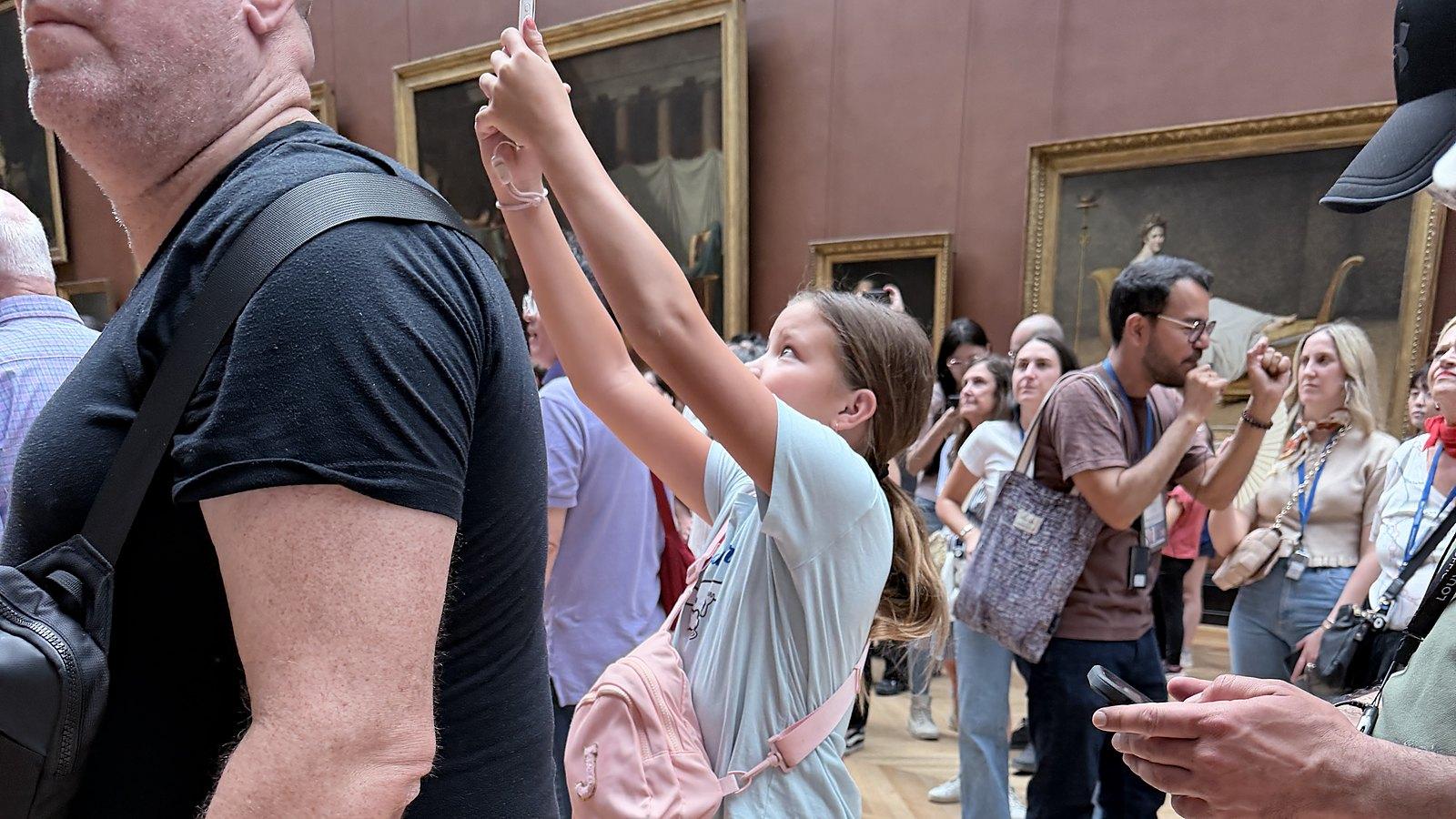
The Mona Lisa hangs in the Salle des États, the Louvre's largest room, in the Denon wing on level 1 (room 711). It sits alone in the centre of the room, in a climate-controlled glass case it has had since 2005. In practice you see it over and between a crowd of raised phones, from a distance. The painting is small; the room is not.
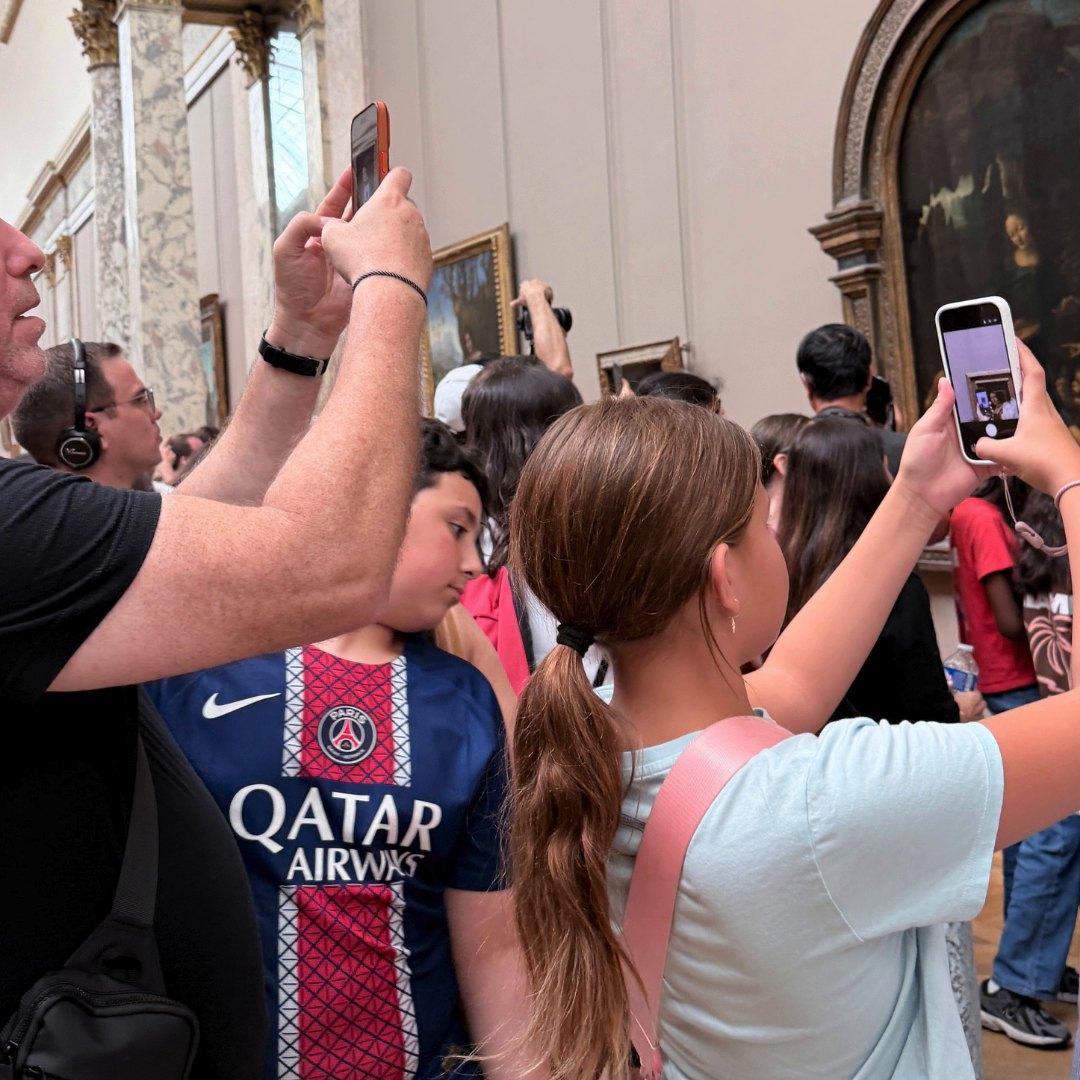
Go early in the visit, while patience is highest, and don't make it the finale. Then turn around. On the opposite wall of the same room is Veronese's enormous Wedding Feast at Cana. It's crowded with people, animals, musicians and small scenes, and it rewards exactly the kind of looking the Mona Lisa crowd makes impossible. Ask the kids to find one person in that painting who isn't paying attention to the party.
If the crowd is the part your kids remember, that's fine too. Seeing hundreds of people photographing one painting is its own small lesson in what makes something famous.
Give them something to find
The trouble with “the Louvre's highlights for kids” is that it turns the visit back into a route, with the same crowds at the same stops. Open-ended prompts work better in a museum this size, because they work in any room. These are the eight in the Adventure Quest Louvre Experience, written so you can use them without the app:
They're deliberately general. They don't send you to named works, and that's the point in a museum you can't finish: the kids choose, and the rooms you're in become the right rooms. Let the finder explain why they chose it. That conversation is usually the best part.
And when a room is already holding them, leave the prompts alone. The aim is attention, not completion. If they're standing in front of a painting arguing about it, the list can wait.
Tickets, time slots and getting in
The Louvre is open 9 a.m. to 6 p.m. on Monday, Thursday, Saturday and Sunday, and until 9 p.m. on Wednesday and Friday. It is closed on Tuesdays, and on 1 January, 1 May and 25 December. Since 14 January 2026, a ticket costs €22 for residents and citizens of the European Economic Area and €32 for other visitors. Under-18s get in free, as do EEA residents under 26.
Book a time slot even for children who don't pay. The museum strongly recommends it for everyone, including free visitors. Only an advance booking guarantees entry, and there's no waiting list. If you arrive outside your slot, you lose your priority and join the same line as visitors without tickets at the Pyramid.
Individual visitors normally enter through the Pyramid, which has separate lines for ticket holders and for visitors without tickets. There's a lift for wheelchairs and prams. Ticket holders can also use the Carrousel entrance at 99 rue de Rivoli. The Porte des Lions entrance on the river side is for ticket holders only, is closed on Tuesdays, and takes its last entry at 5 p.m.
Strollers, bags and breaks
Strollers are allowed, though large models may not fit in the lifts. The museum lends pushchairs and front-worn baby carriers free of charge under the Pyramid, in exchange for ID. Back-worn carriers aren't allowed. Bags larger than 55 × 35 × 20 cm can't go into the museum; there are free self-service lockers under the Pyramid, and everything must be collected the same day. Folding stools can be borrowed at the visitor desk, which is useful for anyone who needs to sit while the kids look.
There are baby-changing tables throughout the museum, and a baby space in the Richelieu wing with bottle warmers and nursing chairs. The Studio, on the ground floor of the Richelieu wing, offers free drawing, reading and short 20-minute activities to anyone with an admission ticket. It's a good mid-visit reset. So is walking out into the Tuileries Garden, which is free and right next door.
Take the outing with you
Louvre Experience is the Adventure Quest adventure for the museum: the eight discoveries above as missions, with a photo for each and a recap of the visit at the end. Six of the eight finish it. It sits in the Paris Explorer collection alongside Eiffel & Champs-Élysées and Notre-Dame Explorer.